Hitachi, Ltd.
Chiplet design can move forward without examining 90% of the options

In the competition to design chiplets, the deciding factor is not chip performance but how quickly constraints on component supply and assembly can be incorporated into the design. Hitachi, Ltd. narrowed down candidates from requirements written in natural language and, in an evaluation using three types of chiplets, cut by more than 90% the number of options designers needed to check. If this judgment can be trusted in real products too, semiconductors could increasingly be reconfigured from components available in factory equipment maintenance rooms.
In chiplet package design, component availability, manufacturing rules, chip placement and connections, heat, electricity, and stress must all be considered at once. Designers have traditionally examined many options one by one, using spreadsheets and their own experience to narrow them down.
What is more, it can turn out only after detailed design has begun that materials are unavailable, heat is building up, or the connections are impractical. Each time, the design must be redone and additional verification carried out. Even if chip performance is improved, that means little if the product cannot be made because of problems with how the chips are combined or supplied.
The difficulty of designing by combining chips
Chiplets are a way of bringing small chips divided by function together in a single package. Instead of creating one large chip from scratch, existing chips can be combined.
But this is not simply a matter of putting components in a box. Connections between chips, ways to dissipate heat, how to deliver power, and differences in the thermal expansion of materials all affect performance and resistance to failure. If high-precision physical simulations are run on every option at the early stage, when there are many candidates, they take time and computing resources. Even high-speed analysis using AI must be tested to ensure that it works correctly with structures or materials it was not trained on.
AI narrows down the options first
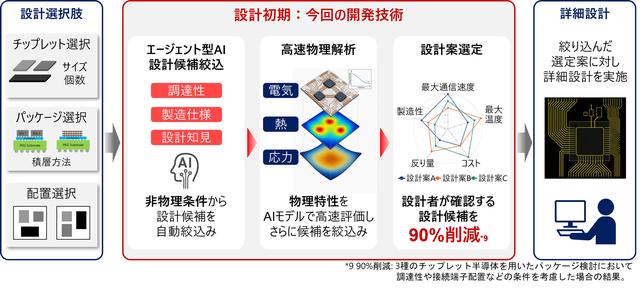
Hitachi, Ltd. has developed a foundational technology that narrows down options at the start of the design process and quickly examines those that remain. Agentic AI organizes requirements written by designers in natural language, then narrows down the options by determining whether components can be procured, whether they meet manufacturing specifications, and whether they are promising in light of knowledge from past designs.
After that, another AI model quickly evaluates electrical, thermal, and stress characteristics. In other words, rather than examining every option in detail, the system first screens out options that are difficult to realize and finds problems with the remaining options early in the design process. In an evaluation using three types of chiplets, the company says it reduced by more than 90% the number of candidates that designers needed to check. It also says it confirmed that concerns about heat, electricity, and stress could be evaluated at an early stage for the narrowed-down options.
Toward a workplace that can rebuild without waiting for components
If this technology can be trusted in real products too, and supply information continues to be updated, semiconductors for AI systems that detect abnormalities in factory equipment maintenance rooms could potentially be rebuilt using chips and circuit boards that are actually available. Situations in which equipment upgrades are delayed while waiting for components might also become less common.
Work at the start of the design process will shift from having skilled experts examine every candidate to quickly comparing options that can actually be realized. This depends, however, on whether the AI that narrows down the options can correctly reflect the latest procurement information and manufacturing constraints, and whether the physical-analysis AI remains reliable outside the range of its training. Hitachi, Ltd. says it will work with chip vendors and packaging-related companies on PoCs to expand the technology’s scope of application and improve the accuracy of its candidate selection.