Hitachi, Ltd.
Robotics Native: Worksites Adapt to Robots

The barriers to widespread robot adoption lie not only in the intelligence of robots, but also in the cost of modifying worksites built for people—and in who bears responsibility for doing so. Hitachi, Ltd. is developing a system in which AI devises work processes and robot configurations at the same time, then narrows down what is feasible using 3D simulations and other tools. If this can meet requirements for safety and maintainability, worksites could emerge where aerial work machines are monitored from below utility poles.
To inspect equipment atop a utility pole, someone has to climb it. To work on the exterior wall of a building, scaffolding must be erected. Today’s worksites are designed on the assumption that people will use stairs and ladders, adapt to places of different shapes, and rely on experience to get the job done. If robots are added later, a single machine has to take on everything from uneven ground and changing procedures to skills that have never been put into words.
Robots Cannot Simply Adapt to the Worksite
Industrial robots have been most effective in factories where the positions and movements of parts are consistent. At construction and maintenance sites, by contrast, the weather, obstacles, and order of operations change. A humanoid robot can more easily use tools designed for people, but it must also walk without falling, maintain its power supply, and make safe contact—all at the same time.
What is more, the cost of automation is not determined by the price of the robot itself. It also includes modifying the worksite, the time when operations must be stopped, maintenance, responsibility for accidents, and quality control. Even if a technology works technically, it will not spread unless it fits safety rules, procurement specifications, and the division of responsibility.
AI Designs the Work and the Robot Together
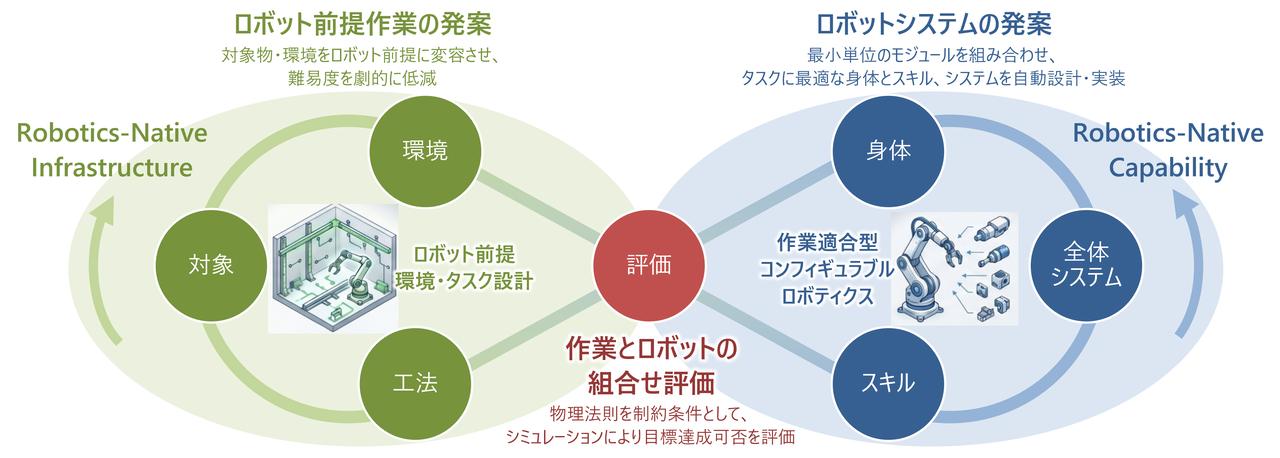
Hitachi, Ltd.’s “Robotics Native” concept changes the idea of forcing robots into worksites designed for people. It means designing the work process, surrounding environment, and the robot’s body and skills together from the outset.
To do this, an AI that devises work processes and an AI that critiques whether they can be implemented exchange proposals. For utility-pole maintenance, they combine actions such as flying, lifting equipment, and moving while clinging to a pole with components such as drones, wheels, and clamps. Using the laws of physics as constraints, the system narrows down proposals that can achieve the objective. Examples include a drone equipped with a manipulator attaching itself to a plate on a utility pole, and a machine gripping the pole and climbing it on wheels. The selected proposals are then checked using 3D models, 3D simulations, and physical mock-ups.
In construction, the company is also exploring processes that do not use scaffolding, such as formwork created by raising a balloon and reinforcing it with mortar. The goal is to create worksites where robots can work more easily, rather than waiting for an all-purpose robot.
Watching Over Maintenance from Below a Utility Pole
If this approach meets real-world requirements for safety, cost, and maintainability, then beneath a utility pole in a suburb, a maintenance worker could watch on a ground-based terminal as a machine attached at a designated position tightens bolts—without having to put on climbing equipment. At a building undergoing renovation, it might also be possible to install work-related mounting equipment and machines instead of scaffolding that covers the sidewalk for a long stretch.
To make this possible, however, the mounting points on utility poles must be standardized, and safety must be demonstrated through remote monitoring. Existing infrastructure will also need to be modified, new construction methods certified and standardized, and costs and responsibilities divided in a way that worksites can accept. Hitachi, Ltd. says it will move forward with joint research, mock-ups, and proof-of-concept projects with user companies and co-creation partners.