Sony CSL
With EMG, devices move before fingers do

Using electromyography (EMG) signals, devices can respond before a finger or muscle begins to move. But for the technology to be practical, users must continue to feel that the action is their own. Research by Sony CSL captured the onset of EMG signals accompanying voluntary movements and tested a method for getting ahead of the user with finger-assist devices and robot hands. If put to practical use, a cursor or robot finger could respond the moment someone at a desk at home tries to move a finger. The condition, however, is that it must not malfunction when worn in everyday life.
Prosthetic hands, robot hands, and input devices controlled by hand movements have so far waited for the user’s fingers or muscles to actually move before responding. Even a slight delay can dull the feel of control and make devices that support bodily movement feel unnatural. Moving first can make them faster, but it also increases the risk that the machine will move in a way the user did not intend.
Signals that appear before muscles move
EMG measures the electrical signals produced when muscles are active, using sensors placed on the skin or elsewhere. Changes in these signals can appear before the muscles actually move. In other words, a device can use the muscles’ preparation to move a finger as a clue, rather than waiting for the finger to move.
But EMG does not always look the same. It changes depending on where the electrodes are placed, sweat, posture, and fatigue, and the way signals appear also differs from person to person. For assistive devices that apply force to the human body, speed is not enough: they must also avoid getting ahead of the user by mistake, and their movements must be predictable.
Moving devices before fingers move
Research by Sony CSL proposed a method that detects the onset of EMG signals accompanying voluntary movements and uses the time before the muscles actually move to activate a device in advance. The researchers also tested how much users felt they had “moved it themselves” when actions were sped up, using devices that assist finger movements, software input controlled by hand movements, and robot hands.
The core of this research is not simply recording reaction times. The question is whether users can feel an action as their own even when the machine moves first. The faster a device reads a user’s intention, the faster it can operate. But if it misreads that intention, the machine may begin a movement the user does not want.
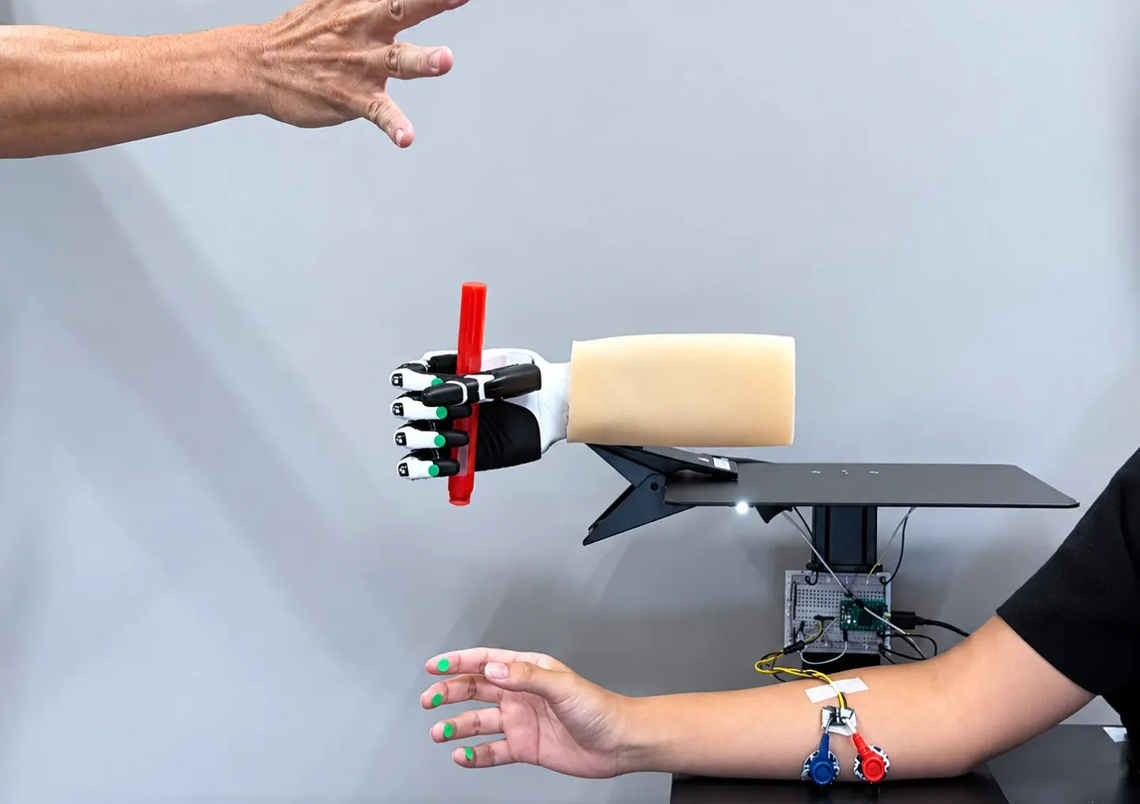
Not making fingers wait at the desk
If this prediction remains stable despite individual differences and everyday noise, while limiting false activations, people wearing devices that support hand function at a desk at home could move a cursor or a robot finger without waiting for their own finger to start moving. For input devices and body-worn interfaces as well, control that does not wait for physical movement could become an option.
But if a device malfunctions during everyday use, or if users cannot maintain the feeling that they are operating it themselves, speed alone will not make it useful for physical assistance. The research paper “Faster Than Muscle: Executing Action based on Voluntary Nervous Signals” will be presented at ACM UIST 2026.