New Energy and Industrial Technology Development Organization (NEDO)
Metabolome Analysis Doesn’t Wait Until Midnight
Automation that separates microorganisms’ fleeting metabolic changes from people’s working hours and differences in manual technique is changing how strains are compared. The New Energy and Industrial Technology Development Organization (NEDO), Kobe University, and Shimadzu Corporation have developed a system that integrates everything from cultivation to sample preparation and delivers culture fluid to a tube for stopping metabolism in about 13 seconds. If it is put into practical use, fermentation development labs will be able to compare where pathways are bottlenecked in different strains using consistent records the next morning, instead of collecting samples at midnight.
In research that uses microorganisms to produce food ingredients, fuel, and other products, a cultivation tank at midnight can become a workplace. That is because substances inside cells change within seconds of being collected. Researchers must take samples at set times, cool them immediately, centrifuge them, and extract them. As the number of samples increases, differences in collection times and procedures become mixed into the data. Samples taken only at times when people can conveniently work cannot be used to compare the moment when cells truly changed.
Reading a Cell’s State in the Moment
A metabolome is a way of measuring all at once the small molecules inside cells, such as sugars, amino acids, and organic acids. Looking at a genetic sequence tells us what kind of blueprint a cell has. But it does not show whether the pathways in that blueprint are actually working, or where raw materials and energy are getting stuck. Measuring metabolites provides information closer to the chemical reactions a cell is carrying out at that moment.
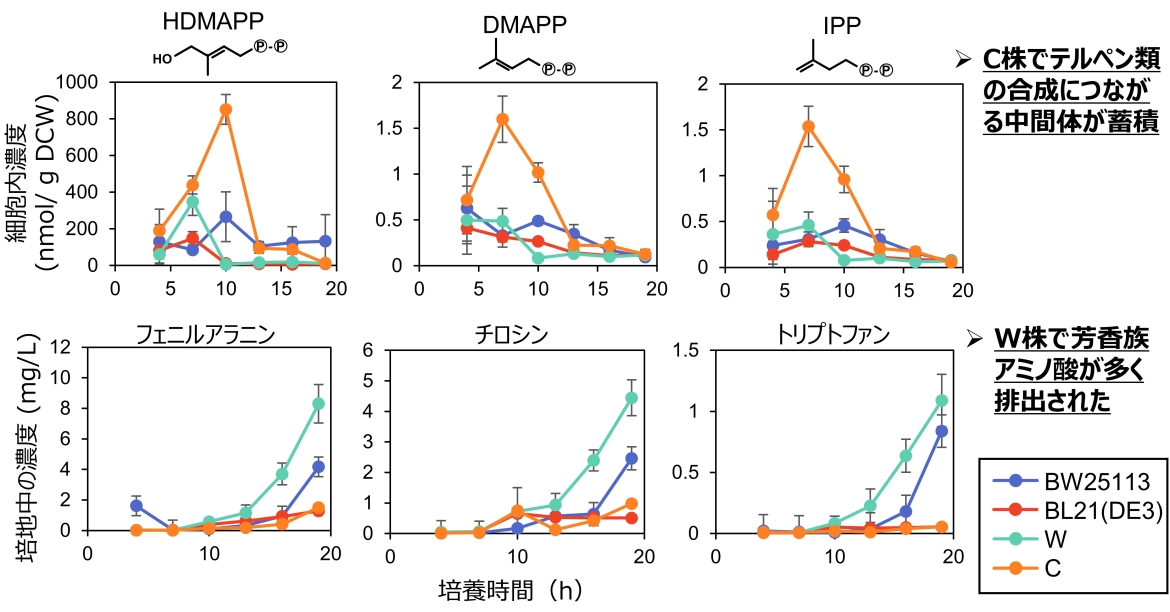
This is also a difference that can be missed if strains are selected only by their growth rates. In four types of E. coli used for industrial applications, the amounts and changes of sugars, amino acids, and energy-related substances differed greatly even at points when their growth rates were similar. No matter how capable the mass spectrometer is, if the metabolic state changes while the sample is being transported to it, the measured values will not represent the original state of the culture.
Keeping the Process Moving from Collection to Extraction
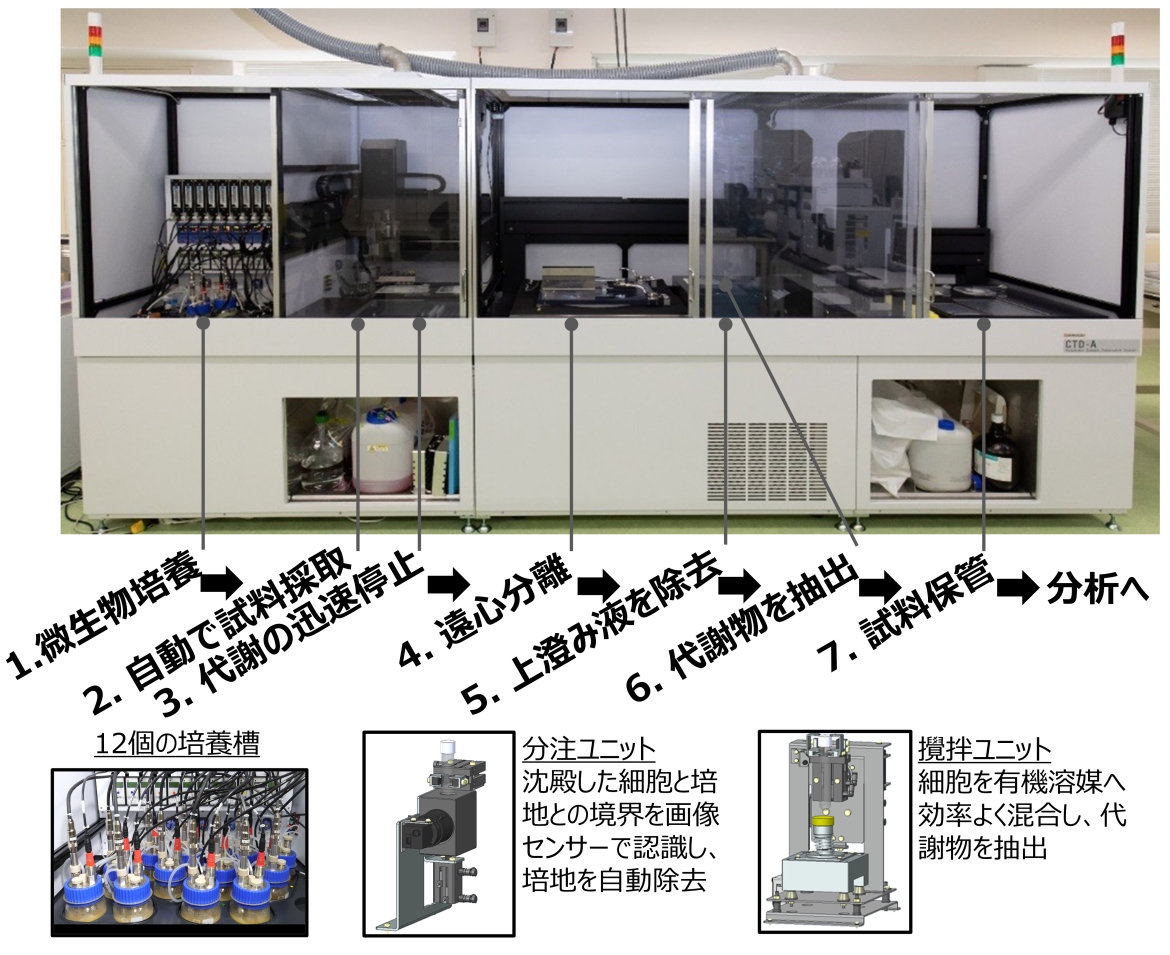
The New Energy and Industrial Technology Development Organization, Kobe University, and Shimadzu Corporation combined collection from the cultivation tank, treatment to stop metabolic reactions, cell recovery, extraction, and dispensing into an analysis plate into a single automated system. The collected culture fluid reaches a tube that stops metabolic reactions in about 13 seconds. Cooling centrifugation, liquid removal, transport, dispensing, and extraction through heating, shaking, and mixing are then carried out consecutively at set times.
The cultivation tank, collection time, processing steps, and position on the analysis plate are linked by barcodes. Temperature, equipment operation, images, and sample IDs are also recorded, so the same procedures can be repeated without someone having to keep working by hand, second by second, through the night. The organizations that announced the system say it is the world’s first to integrate and automate everything from cultivation to the preparation of samples for metabolome analysis.
A Development Lab That Can Compare Results in the Morning
If this system works consistently over long-term operation, developers will be able to check the next morning, using records in the same format, which strains had bottlenecks in the pathway to the target compound, instead of cooling samples in front of cultivation tanks late at night or early in the morning. One possible setting is a fermentation development lab next to a food factory, where many strains and cultivation conditions can be compared according to changes in the cells rather than people’s working hours.
However, simply being able to measure things automatically will not by itself increase productivity. Researchers still need to correctly choose which genes or cultivation conditions to modify based on the data, and reproduce their effects in actual production equipment. Metabolites that cannot be detected, interpreting analysis results, and scaling up to mass cultivation also remain separate challenges. The system has been implemented at Kobe University’s DBTL-based Smart Cell Development Center and is available for companies to use.