French National Centre for Scientific Research (CNRS)
The real issue with radioactive waste drums is what they let out
A French scientific mission observed highly degraded radioactive waste drums at a depth of 4,700 meters, some of which were releasing their contents. Samples of water, sediment, and organisms must now show whether radionuclides are moving through the abyssal ecosystem. The question is therefore shifting from where the drums are to what they are releasing and how to monitor it.
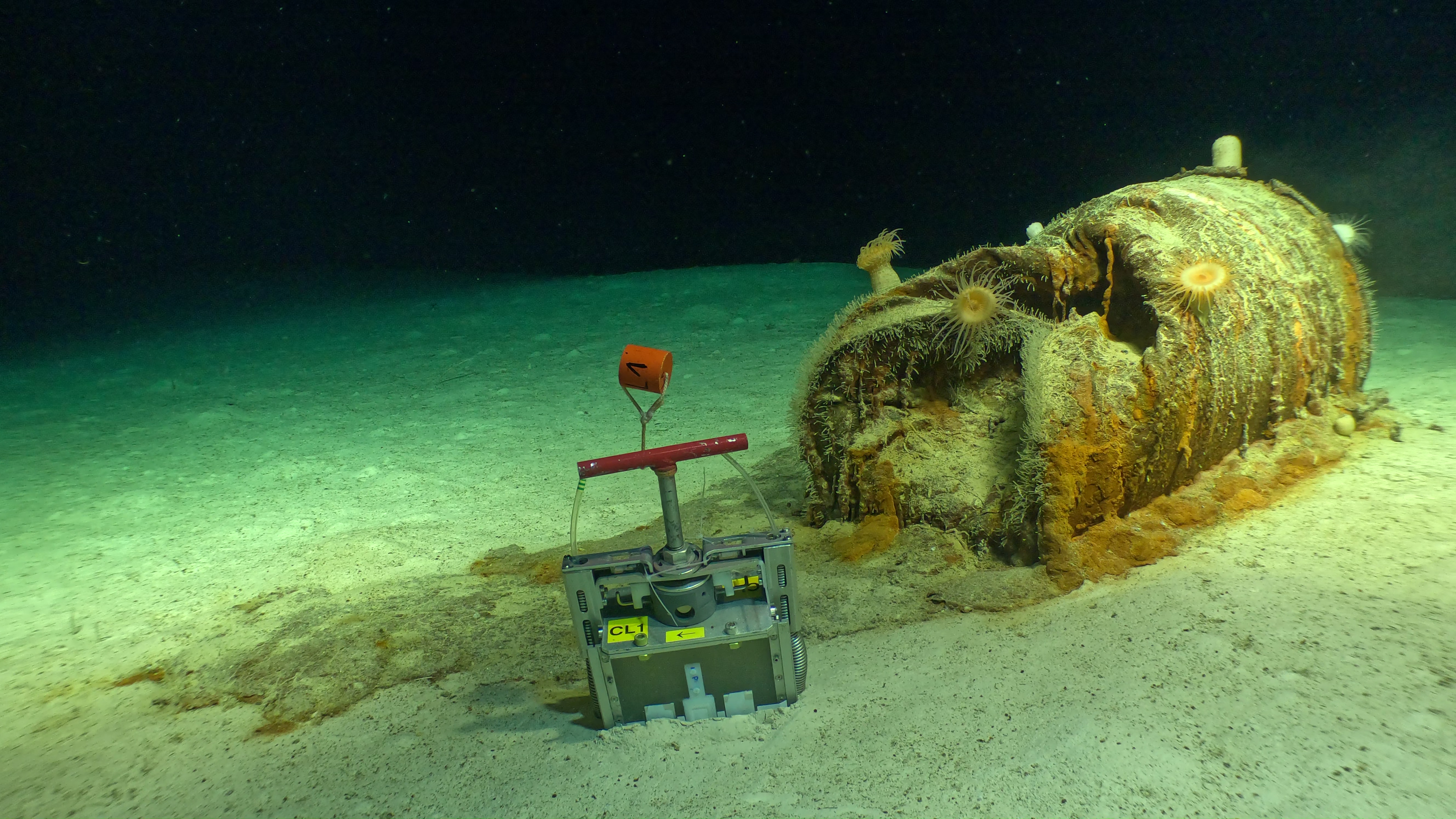
The first NODSSUM campaign, in 2025, mainly answered a mapping question: Where are the drums submerged in the Northeast Atlantic? The second mission shifted the focus. At more than 4,700 meters below the surface, scientists directly observed several drums and their surroundings. Some were highly degraded and were releasing material onto the seafloor.
The decisive issue is therefore no longer just the location of the deposits. It is what the drums release, followed by the path those substances take through the water, sediments, and living organisms.
A deposit that does not remain sealed
Between 1950 and 1990, more than 200,000 radioactive waste drums were submerged in the abyssal depths of the Northeast Atlantic. Their depth may give the impression that this waste is separated from the living world. But a submerged container is not an eternal barrier. Corrosion and the degradation of materials can create pathways for its contents to escape.
The presence of a radionuclide—a radioactive atom—near waste is not, however, enough to show that it has entered the ecological chain or to measure its consequences. It is necessary to know whether it passes into the water, attaches to sediments, or is absorbed by organisms.
This is difficult to observe in the abyss. Teams must descend to the site, collect samples, and take measurements that make it possible to distinguish a local deposit from dispersion.
Seeing what comes out of the drums
The Nodssum 2026 mission, conducted from May 27 to June 28, carried around 30 scientists aboard the Pourquoi Pas ?. The manned submersible Nautile made 20 dives. The teams identified different coatings, made of resin, bitumen, or cement, and then observed the condition of the drums and the seafloor around them.
Several drums showed advanced degradation. Some were releasing their contents onto the seafloor. Measurements taken on site confirmed the presence of radionuclides characteristic of the waste, at activity levels higher than those expected in this area. The CNRS specifies that these levels allow the samples to be handled without major radiation-protection constraints. This describes the scientists’ working conditions, but does not yet make it possible to draw conclusions about effects on the ecosystem.
The team therefore collected water, sediment, and living organisms. These samples should help trace radioactivity from the materials into the abyssal environment. “Drum showing significant degradation, discharge of material onto the surrounding seafloor, and sediment-sampling equipment,” reads the caption for Figure 2 of the mission.
Decisions based on transfers
Laboratory analyses will continue over the coming months. Their aim will be to link the radionuclides measured to the materials in the drums, the sediments, the water, and the organisms collected. It will then be necessary to quantify these transfers and their effects on abyssal ecosystems.
If these links are established, monitoring will no longer be able to rely solely on a map of the sites. Authorities responsible for nuclear safety and marine monitoring will have data to target their inspections. Decisions about this old waste will be able to take into account the actual condition of the drums and the ecosystems, rather than just their historical location.
This remains a possibility, not an established result. Depth and dilution are not enough to settle the question if the transfers are confirmed. Their scale must still be measured and their effects understood.