National Institute of Advanced Industrial Science and Technology (AIST)
The Starting Point for a Small Genome-Editing Tool Was Structure, Not Enzyme Performance

Large editing enzymes are difficult to deliver into cells, and overseas patents can also be a barrier. A team including AIST searched for candidates based not on enzyme sequences but on three-dimensional structures. The small enzyme, about 600 amino acids long, showed an editing efficiency of about 60% in cultured human cells, and was also shown to work in plants. If delivery and safety can be confirmed, it could expand the options for breeding and therapeutic development in Japan.
Genome editing is a technology that cuts DNA at a targeted location and uses the cell’s own repair mechanisms to disrupt genes or change sequences. The cutting site is specified by guide RNA. But large DNA-cutting proteins such as the widely used CRISPR-Cas9 are difficult to deliver into cells. In plants, there was also the challenge that they do not work well enough at low growth temperatures. Commercial use in Japan also required license negotiations and rights clearance for foundational patents originating overseas.
Size was not the only barrier—patent rights were one too
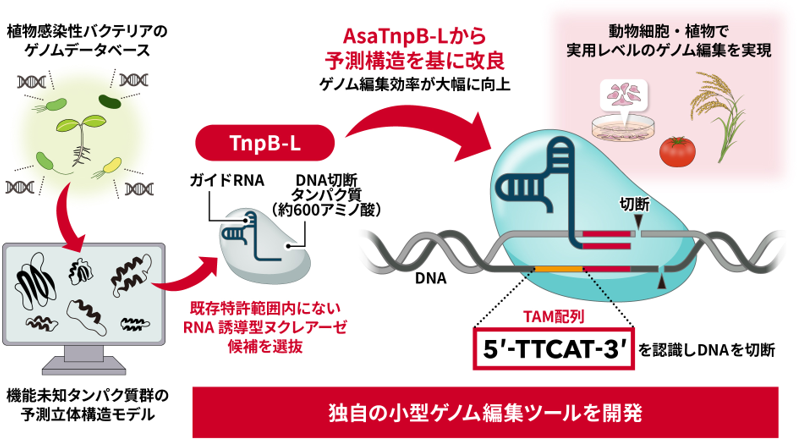
A team from the National Institute of Advanced Industrial Science and Technology (AIST), TOPPAN Holdings, and Implant Innovation developed AsaTnpB-L, a DNA-cutting protein derived from the plant-infecting bacterium Agrobacterium salinitolerans. It is about 600 amino acids long—less than half the 1,368 amino acids in SpCas9. It works with one molecule of the DNA-cutting protein and one molecule of guide RNA.
The key was searching for candidates based on structure rather than known sequences. The team converted genes of unknown function from plant-infecting bacteria into predicted three-dimensional structures, then screened for those with shapes resembling known DNA-cutting proteins. This avoided competing over known sequences crowded with patents, and also marked a starting point for creating a genome-editing platform that could be used domestically.
Looking at shape to improve performance
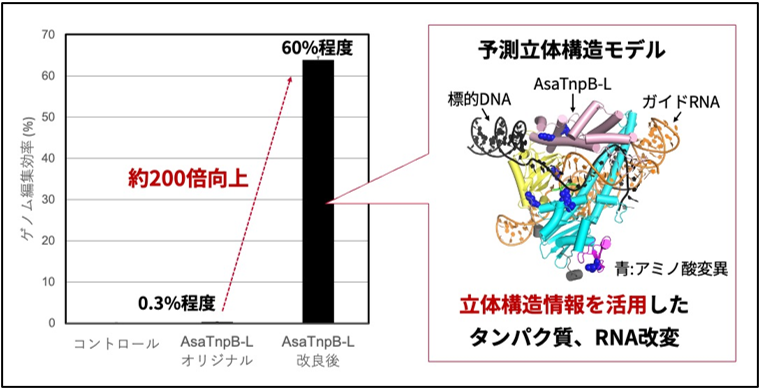
AsaTnpB-L recognizes the adjacent sequence 5’-TTCAT-3’—the TAM sequence—and cuts DNA according to the guide RNA. Using the three-dimensional structure as a clue, the team changed amino acids at the sites where the protein and guide RNA come into contact. As a result, it achieved an editing efficiency of about 60% in cultured human cells. It also changed the TAM sequence recognized by the protein to 5’-TBAT-3’. B represents T, C, or G.
Implant Innovation demonstrated that the tool can also be used in plants. The technology has been patented in Japan, and part of it has been registered as Patent No. 7821459. According to the organizations that announced the work, the improved version was independently designed and developed so that it would not infringe existing patents held by other parties in Japan.
What it takes to expand where it can be delivered
If delivery and safety are established and the tool becomes available for large-scale use, it could expand the options for developing disease-resistant crops and varieties suited to local conditions. Even when cells are edited outside the body for therapeutic use, the size of the equipment may become less restrictive in treatment design. If patents that can be used domestically, standard reagents, and design methods are put in place, universities and small and medium-sized companies may also find it easier to participate in breeding and biomanufacturing.
However, off-target effects that cut DNA outside the intended target, delivery for each target cell and plant species, and long-term safety still need to be confirmed. The constraints imposed by TAM and PAM sequences also remain. Whether these issues can be checked while maintaining high efficiency will determine whether the technology can be put to practical use.